
Molecular Breakdown: Advanced Skincare Audits (2026)
Welcome to the Molecular Breakdown clinical directory at Gent Armor—a scientific archive dedicated to analyzing active skincare ingredients at the biochemical, structural, and cellular levels.
In modern clinical dermatology, product efficacy isn’t determined by marketing claims or impressive ingredient percentages alone. True physiological results depend on chemical stability, formulation pH, molecular mass (in Dalton units), and transdermal bioavailability. Through our comprehensive Molecular Breakdown series, we analyze topicals to decode how active compounds penetrate the lipid matrix, bind to cellular receptors, and regulate dermal repair pathways.
The Scientific Framework: How We Analyze Compounds
Evaluating topicals requires looking beyond surface layer hydration. Through our detailed biochemical ingredient audits, we evaluate four primary physicochemical parameters to determine real-world performance.
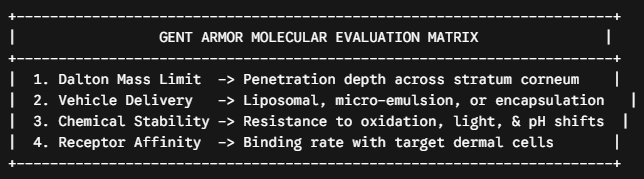
When conducting a Molecular Breakdown of any active compound, our clinical framework prioritizes the following physiological indicators:
- The 500-Dalton Penetration Rule: Compounds exceeding $500\text{ Da}$ encounter structural resistance passing through the intercellular lipids of the stratum corneum unless modified by specialized lipid-encapsulation or micro-emulsion systems.
- Formulation pH Alignment: Active compounds like L-Ascorbic Acid require low, acidic environments ($\text{pH } < 3.5$) for stability and absorption, while signaling peptides require neutral environments ($\text{pH } 5.5\text{–}6.5$) to prevent molecular degradation.
- Bioavailability & Lipid Affinity: Lipophilic molecules migrate through intercellular pathways more readily than hydrophilic compounds, dictating whether a formula works at the epidermal surface or deeper within dermal layers.
Core Categories in Our Molecular Index
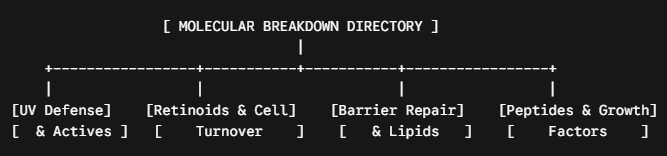
To help you build a targeted protocol, our Molecular Breakdown directory categorizes active ingredients into four specialized scientific branches:
1. UV Defense & Actives Index
Photoprotection forms the foundation of any anti-aging protocol. Modern photobiology distinguishes between chemical filters that absorb UV radiation and inorganic physical blocks that reflect radiation.
In our Molecular Breakdown of photoprotective agents, we analyze both traditional filters and next-generation chemical filters:
- Inorganic Physical Filters: Micro-fine Zinc Oxide and Titanium Dioxide offer broad-spectrum attenuation across UVA1, UVA2, and UVB wavelengths without triggering inflammatory heat pathways.
- Next-Gen Organic Filters: Advanced chemical filters such as Tinosorb M, Tinosorb S, and Uvinul A Plus have higher molecular weights, which help prevent systemic absorption while delivering superior photostability under high UV radiation.
1. UV Defense & Actives Index
Photoprotection forms the foundation of any anti-aging protocol. Modern photobiology distinguishes between chemical filters that absorb UV radiation and inorganic physical blocks that reflect radiation.
In our Molecular Breakdown of photoprotective agents, we analyze both traditional filters and next-generation chemical filters:
- Inorganic Physical Filters: Micro-fine Zinc Oxide and Titanium Dioxide offer broad-spectrum attenuation across UVA1, UVA2, and UVB wavelengths without triggering inflammatory heat pathways.
- Next-Gen Organic Filters: Advanced chemical filters such as Tinosorb M, Tinosorb S, and Uvinul A Plus have higher molecular weights, which help prevent systemic absorption while delivering superior photostability under high UV radiation.
2. Retinoids & Cell Turnover Mechanics
Vitamin A derivatives remain unmatched in their ability to stimulate collagen synthesis and accelerate epidermal differentiation. However, understanding their chemical activation chain is critical to managing irritation.
| Retinoid Form (Compound) | Conversion Steps to Active Form |
| Retinyl Palmitate | 3 Conversions (Requires 3 enzymatic steps to become Retinoic Acid) |
| Retinol | 2 Conversions (Requires 2 enzymatic steps to become Retinoic Acid) |
| Retinaldehyde (Retinal) | 1 Conversion (Direct single-step oxidation to Retinoic Acid) |
| Retinoic Acid (Tretinoin) | Direct Binding (0 Conversions required; binds directly to RAR receptors) |
Through our Molecular Breakdown of vitamin A analogs, we trace the conversion pathway of topical retinoids:
- Tretinoin (All-Trans Retinoic Acid): Requires zero enzymatic conversion, binding directly to nuclear retinoic acid receptors (RARs) for rapid epidermal turnover, though presenting higher potential for skin barrier disruption.
- Retinaldehyde (Retinal): Requires a single enzymatic oxidation step to convert into retinoic acid, offering up to 11 times faster kinetic conversion than standard retinol with significantly lower erythema profiles.
- Hydroxypinacolone Retinoate (HPR): A next-generation retinoic acid ester that binds directly to retinoic acid receptors without requiring prior enzymatic conversion, combining high potency with minimal irritation.
3. Barrier Repair & Lipid Architecture
The stratum corneum operates on a precise 3:1:1 lipid ratio composed of Ceramides, Cholesterol, and Free Fatty Acids. When this ratio breaks down, Transepidermal Water Loss (TEWL) increases, accelerating cutaneous sensitivity and inflammation.
| Active Compound | Molecular Function | Primary Skin Indication |
| Ceramides (NP, AP, EOP) | Structural lipid matrix repair | Barrier restoration & moisture locking |
| Cholesterol | Membrane fluidity regulation | Restoring lipid equilibrium in mature/compromised skin |
| Polydeoxyribonucleotide (PDRN) | Adenosine $A_{2A}$ receptor stimulation | Cellular regeneration & rapid tissue repair |
| Beta-Glucan | Deep epidermal hydration & macrophage stimulation | Soothing inflammation & post-procedure recovery |
4. Peptides & Growth Factors Signaling
Peptides act as cellular messengers, instructing dermal fibroblasts to synthesize structural proteins like collagen, elastin, and fibronectin.
- Signal Peptides (e.g., Palmitoyl Tripeptide-1, Palmitoyl Tetrapeptide-7): Mimic dermal extracellular matrix degradation fragments, triggering new collagen synthesis pathways.
- Carrier Peptides (e.g., Copper Tripeptide-1 / GHK-Cu): Deliver trace elements essential for wound healing and enzymatic repair to dermal tissue.
- Neuropeptides (e.g., Acetyl Hexapeptide-8): Inhibit neurotransmitter release at the neuromuscular junction to visibly relax expression line depth.
Biochemical Workflow & Audit Methodology
Every compound analyzed in our Molecular Breakdown index undergoes a four-step clinical assessment workflow:
| Step | Phase | Focus & Analytical Criteria |
| 01 | In-Vitro & In-Vivo Data Extraction | Peer-reviewed dermatological literature & clinical trial analysis |
| 02 | Molecular Structure & Stability Testing | Compound formulation pH, oxidation susceptibility, and vehicle delivery |
| 03 | Barrier Compatibility Evaluation | Transepidermal Water Loss (TEWL) impact & lipid layer preservation |
| 04 | Synergy & Compatibility Audit | Co-formulation safety, chemical stability, and ingredient incompatibilities |
How to Apply Molecular Insights to Your Routine
To build a high-performance skincare routine using our Molecular Breakdown research, follow these clinical application principles:
Evaluate Compound Size and pH First: Apply low-pH acidic compounds (like Vitamin C or AHA/BHA) directly to clean skin before layering neutral-pH serums or lipid emulsions.
Prioritize Bioavailable Encapsulation: When selecting sensitive actives like Retinoids or Peptides, opt for liposomal or micro-encapsulated delivery vehicles that protect active molecules from premature degradation.
Respect Molecular Compatibility: Avoid layering active ingredients that destabilize each other (e.g., direct copper peptides combined with low-pH L-Ascorbic Acid).
For additional peer-reviewed data on dermatological compounds and ingredient safety guidelines, explore research publications at the National Center for Biotechnology Information (NCBI).
Frequently Asked Questions (FAQ)
What is a "Molecular Breakdown" and why does molecular weight matter?
A Molecular Breakdown evaluates the precise biochemical structure, mass, and absorption mechanisms of an active ingredient. Molecular weight—measured in Daltons (Da)—determines how deep an active compound can penetrate skin layers. Smaller molecules ($\le 500\text{ Da}$) pass through the lipophilic intercellular lipid matrix into deeper epidermal layers, whereas larger molecules remain on the surface as protective or hydrating film-formers.
Can high molecular weight ingredients still benefit the skin?
Yes. High molecular weight actives—such as macro-Hyaluronic Acid or high-molecular-weight Beta-Glucan—serve vital roles as surface humectants and barrier protectants. They create a breathable film over the stratum corneum, locking in surface hydration and shielding compromised skin from environmental irritants while lower molecular weight compounds work beneath the surface.
How often are compounds in this directory re-evaluated?
Our clinical research team regularly updates every entry in our Molecular Breakdown library as new peer-reviewed clinical trials, bio-delivery systems, and dermatological safety assessments are published.
How do delivery vehicles (like liposomes) affect an ingredient's molecular performance?
Delivery vehicles act as protective transport systems for active ingredients. Encapsulating a delicate molecule in a lipid-based liposome or micro-emulsion prevents rapid oxidation, improves transdermal penetration across the stratum corneum, and enables targeted, slow-release delivery into deeper skin layers without causing surface irritation.
Why do certain active ingredients destabilize when layered together?
Destabilization typically occurs due to differences in required formulation pH or direct chemical reactivity. For example, pairing low-pH exfoliating acids with copper peptides breaks down the complex peptide chains, rendering them inactive. Reviewing a formula’s Molecular Breakdown helps ensure your layered products remain active and chemically compatible.
Explore Our Molecular Audits
Refine your daily protocol with our detailed active ingredient breakdowns:
- PDRN & Salmon DNA Mechanics: Understanding Cellular Regeneration in Male Skin.
- Tretinoin vs. HPR vs. Retinal: Decoding Vitamin A Conversion Pathways.
- Copper Tripeptide-1 Audit: How GHK-Cu Stimulates Dermal Fibroblasts.
- Zinc Oxide vs. Next-Gen UV Filters: Photostability & UVA Attenuation Breakdown.
Editorial Note: The clinical analyses provided within the Molecular Breakdown index are designed for educational and analytical purposes. Always consult a board-certified dermatologist before beginning high-potency clinical protocols.