
Ingredient Face-Offs: Proven Active Audits (2026)
Welcome to Ingredient Face-Offs by Gent Armor—the definitive clinical hub for evidence-based active ingredient evaluations, molecular bioavailability comparisons, and male skin barrier optimization protocols.
In modern dermatological science, high concentration alone does not guarantee efficacy. The actual performance of any skincare regimen depends on molecular weight, vehicle delivery systems, formulation pH, and cellular receptor affinity. Our Ingredient Face-Offs series strips away marketing hype to conduct rigorous, data-driven comparisons of clinical active ingredients, empowering you to build a streamlined, highly effective skincare routine.
The Philosophy Behind Clinical Ingredient Comparisons
Selecting the right active ingredients often feels overwhelming due to conflicting clinical claims and commercial noise. Through our comprehensive active ingredient comparisons, Gent Armor provides objective, unbiased analytical frameworks designed to evaluate how compound formulations interact with the stratum corneum.
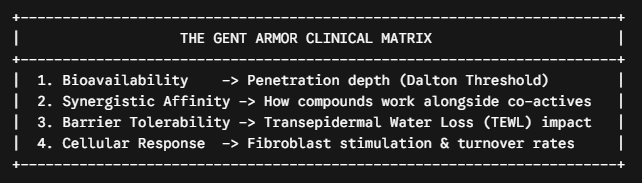
When evaluating topicals, our clinical skincare face-offs examine essential physiological factors:
- Molecular Weight (Dalton Unit): Determining whether an active compound can penetrate the lipophilic intercellular matrix of the skin barrier or merely rest on the surface.
- pH Sensitivity: Assessing whether an acid or antioxidant maintains stability and efficacy at skin-compatible pH levels.
- Cellular Pathways: Identifying whether an ingredient stimulates collagen synthesis, inhibits tyrosinase activity, or mitigates oxidative stress via specific signal peptides.
By centering our analysis on these biochemical parameters, each of our Ingredient Face-Offs offers a clear roadmap for selecting ingredients tailored to your specific skin architecture.
Head-to-Head Active Audits: The Core Face-Offs
To simplify your routine, our ongoing molecular ingredient audits group key dermatological actives into head-to-head functional showdowns. Below is a breakdown of our primary analytical categories.
1. Retinoids vs. Next-Gen Alternatives (Cellular Turnover)
Retinoids remain the gold standard for dermal remodeling and anti-aging. However, irritation protocols demand an examination of both classical derivatives and modern botanical alternatives.
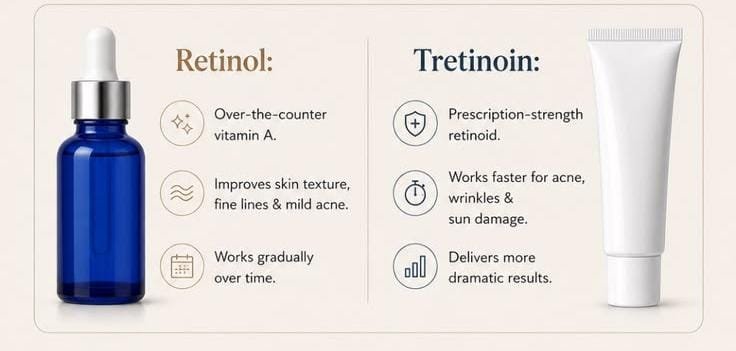
- Tretinoin vs. Retinol: A direct comparison of direct retinoic acid versus conversion-dependent derivatives. Tretinoin acts instantly on retinoic acid receptors (RARs) but presents higher potential for erythema. Retinol requires a two-step enzymatic conversion, offering a gentler, steady-release profile.
- Retinol vs. Bakuchiol: In our skincare active showdown between vitamin A and meroterpene compounds, clinical data indicates Bakuchiol stimulates similar collagen-gene expression pathways without disrupting the lipid barrier, making it an ideal candidate for reactive or sensitive skin profiles.
2. Barrier Repair Actives: PDRN vs. Copper Tripeptide-1
When the cutaneous barrier is compromised—whether due to over-exfoliation, post-procedure recovery, or environmental aggression—selecting the correct restorative compound is vital.
| Metric / Attribute | Polydeoxyribonucleotide (PDRN) | Copper Tripeptide-1 (GHK-Cu) |
| Primary Mechanism | Adenosine $A_{2A}$ receptor activation; anti-inflammatory signaling | Fibroblast stimulation; extracellular matrix gene regulation |
| Primary Indication | Rapid tissue regeneration & tissue repair | Collagen synthesis & enzymatic elasticity support |
| Penetration Depth | Moderate (optimized via micro-needling/nano-delivery) | High (low molecular peptide structure) |
| Synergy Potential | Excellent with Hyaluronic Acid & Ceramides | Excellent with Niacinamide & Non-acidic hydration |
3. Exfoliating Acids: Salicylic Acid (BHA) vs. Glycolic Acid (AHA)
Chemical exfoliation hinges on molecular lipid solubility. Selecting between Alpha and Beta Hydroxy Acids requires understanding your skin’s sebum production profile.
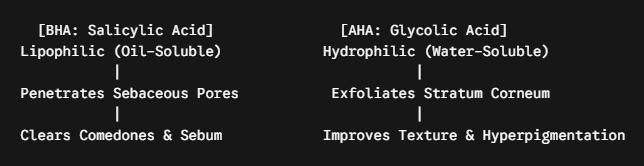
- Salicylic Acid: Being lipophilic, BHA penetrates deep into the pilosebaceous unit to dissolve cellular debris and excess sebum, making it the primary choice for acne-prone or congestion-heavy skin.
- Glycolic Acid: As the smallest AHA molecule (76 Daltons), Glycolic Acid breaks down desmosomes in the upper epidermal layer to boost cellular turnover and smooth surface roughness, though it demands strict UV protection due to photosensitivity risks.
4. Hydration Mechanics: Beta-Glucan vs. Hyaluronic Acid
While Hyaluronic Acid is widely celebrated as a hydrating standard, molecular research highlights superior alternative polysaccharides.
In our specialized molecular ingredient audits, Beta-Glucan consistently outperforms standard Hyaluronic Acid in long-term moisture retention and anti-inflammatory properties. Beta-Glucan features a molecular structure that penetrates the stratum corneum more deeply despite a larger molecular size, offering a $20\%$ higher hydration retention capacity under low-humidity conditions while promoting macrophage activity for wound healing.
How We Conduct Our Clinical Audits
Every entry in our Ingredient Face-Offs library follows a rigorous, non-biased clinical methodology. We evaluate ingredients using peer-reviewed dermatological studies, clinical trials from published databases like PubMed Central, and real-world dermal tolerance assessments.
| Step | Phase | Focus & Analytical Criteria |
| 01 | In-Vitro & In-Vivo Data Extraction | Peer-reviewed dermatological literature & clinical trial analysis |
| 02 | Molecular Structure & Stability Testing | Compound formulation pH, oxidation susceptibility, and vehicle delivery |
| 03 | Barrier Compatibility Evaluation | Transepidermal Water Loss (TEWL) impact & lipid layer preservation |
| 04 | Synergy & Compatibility Audit | Co-formulation safety, chemical stability, and ingredient incompatibilities |
Key Criteria Analyzed in Every Face-Off:
- Bioavailability and Molecular Delivery: We verify whether an ingredient’s delivery system (e.g., liposomal encapsulation, micro-emulsions) successfully delivers active molecules to target dermal layers.
- Clinical Efficacy vs. Marketing Hype: We cross-examine brand claims against independent double-blind, placebo-controlled trials.
- Barrier Integrity Impact: We measure Transepidermal Water Loss (TEWL) parameters to ensure active ingredients do not compromise the skin’s protective coat.
- Formulation Compatibility: We analyze ingredient synergy, detailing which active ingredients can be safely layered (e.g., Niacinamide with Retinoids) and which combinations cause irritation (e.g., L-Ascorbic Acid with Direct AHAs).
Optimizing Your Protocol Using Our Ingredient Audits
To get the most out of our clinical skincare face-offs, follow this structured approach when modifying your daily routine:
- Identify Your Primary Skin Objective: Determine whether your current goal is cutaneous barrier repair, sebum control, hyperpigmentation reduction, or anti-aging mitigation.
- Consult the Relevant Ingredient Face-Off: Review our comparative audits to analyze which compound offers the highest affinity for your specific skin type.
- Account for Formulation Synergy: Ensure that newly introduced actives do not clash with your existing regimen. For instance, pairing active peptide protocols with low-pH exfoliating acids can denature delicate amino acid chains.
- Implement Staggered Patch Testing: Introduce active molecules sequentially, monitoring cutaneous feedback over a 14-day cycle before escalating usage frequency.
For broader perspectives on dermatological research, ingredient stability guidelines, and clinical skincare standards, consult established clinical resources at the American Academy of Dermatology (AAD).
Frequently Asked Questions (FAQ)
What makes an "Ingredient Face-Off" different from a standard product review?
Our Ingredient Face-Offs analyze the pure, active biochemical compounds rather than branded finished products. By evaluating molecular weight, delivery mechanism, bioavailability, and clinical literature, we provide an objective analysis of how the ingredient itself functions within the skin, independent of brand marketing.
Can two active ingredients from a face-off be used together in the same routine?
It depends on the specific molecular properties of the compounds. Some face-off pairs—like Niacinamide vs. Vitamin C—can actually complement each other when formulated at stabilized pH levels or used at different times of the day (e.g., Vitamin C in the AM, Niacinamide/Retinoids in the PM). However, combining aggressive exfoliants like Salicylic Acid and Glycolic Acid simultaneously can strip the lipid barrier and induce inflammation.
How often are these active ingredient audits updated?
Our clinical research team regularly updates every skincare active showdown as new peer-reviewed dermatological studies, clinical trial data, and delivery technologies emerge. We review formulations annually to reflect modern clinical standards.
How do molecular weight and bioavailability dictate which active wins an "Ingredient Face-Off"?
Molecular weight—measured in Daltons (Da)—is the primary chemical threshold determining whether a topical active ingredient actually penetrates the epidermis or merely rests on the stratum corneum. According to the clinically accepted 500-Dalton Rule, compounds with a molecular weight under $500\text{ Da}$ can effectively cross the lipophilic cutaneous lipid matrix to reach deeper basal layers and stimulate cellular receptors.
In our Ingredient Face-Offs, bioavailability isn’t evaluated solely by percentage concentration, but by delivery architecture. For instance, a high-percentage active compound with a large molecular mass (e.g., standard high-molecular-weight Hyaluronic Acid at $1,500,000\text{ Da}$) will act purely as a surface humectant. Conversely, micro-encapsulated or low-molecular-weight actives (like Oligopeptides or micro-PDRN) bypass surface resistance to interact directly with fibroblast pathways and keratinocytes. Therefore, an active compound with superior bioavailability and a lower molecular mass will consistently outperform a higher-concentration, non-penetrative alternative in our clinical audits.
How should I layer different active ingredients without inducing barrier breakdown or inflammation?
Answer: Successful active ingredient layering relies on understanding chemical pH compatibility, cellular tolerance, and the integrity of the skin’s natural moisture barrier. When combining high-potency topical actives, the primary risk is Transepidermal Water Loss (TEWL) caused by over-exfoliation or excessive cellular acid exposure.
To optimize layer synergy while preventing barrier disruption, follow these three core clinical guidelines:
Separate by pH Levels: Low-pH actives such as direct L-Ascorbic Acid (Vitamin C) or Glycolic/Salicylic Acids (pH 3.0–3.5) should not be layered directly with neutral-pH peptides or Niacinamide (pH 5.5–6.5). Mixing them can denature protein structures or cause intense cutaneous flushing.
Stagger Active Application (AM vs. PM): Reserve unstable or photosensitizing actives—such as Retinoids and Exfoliating Acids—for your evening (PM) protocol. Use stabilizing antioxidants, hydrating polysaccharides (like Beta-Glucan), and barrier-supportive lipids during your morning (AM) routine to protect against environmental oxidative stress.
Follow the Molecular Density Rule: Always apply products in order of molecular density—starting with water-based serums, moving to lipid-based micro-emulsions, and ending with occlusive barrier repair creams. This ensures lower-molecular-weight actives penetrate fully without being blocked by heavier lipophilic molecules.
Explore the Latest Ingredient Face-Off Audits
Ready to dive deeper into specific active ingredient comparisons? Browse through our latest published audits below to refine your daily skin regimen with science-backed precision:
- Retinol vs. Bakuchiol: Which Cell Turnover Active Wins for Sensitive Male Skin?
- Salicylic Acid vs. Glycolic Acid: Choosing the Right Acid for Pore Congestion & Texture.
- Copper Peptides vs. Vitamin C: A Molecular Comparison for Skin Remodeling.
- Niacinamide vs. Azelaic Acid: Targeting Redness, Sebum Control, and Post-Inflammatory Hyperpigmentation.